
If you’ve been told you have a disc problem, the terminology can feel confusing. One provider may mention a bulging disc, someone else may call it a slipped disc, and your MRI report may use the word herniation. These terms are related, but they don’t all mean the same thing.
Understanding the difference can help you make more sense of your symptoms and feel more confident about your next steps. Below, we explain what bulging, herniated, and slipped discs mean, what symptoms you may notice, when to seek urgent care, and how the chiropractors at Tangelo Health approach herniated disc treatment in Seattle.

A Quick Look at Your Spinal Discs
Your spine is made up of individual bones called vertebrae. Between each one is a disc that acts like a cushion.
Each disc has:
- A tough outer layer
- A softer, gel-like center
These discs help absorb pressure and allow your spine to move comfortably when you bend, twist, or lift. Disc problems are most common in the lower back, also known as the lumbar spine, and the neck, or cervical spine. Over time, discs naturally become less flexible. Other factors may also increase the chance of disc changes, including:
- Lifting with poor mechanics
- Sudden injuries
- Carrying extra body weight
- Smoking
- Spending long periods sitting or driving [1]
What Is the Difference Between a Bulging and Herniated Disc?
Although the terms are sometimes used interchangeably, a bulging disc and a herniated disc are not quite the same.
Bulging Disc
A bulging disc happens when part of the outer edge of the disc extends beyond its usual space. The outer layer is still intact, but the disc has widened or pushed outward. Bulging discs are often associated with normal age-related changes and may or may not cause symptoms.
Herniated Disc
A herniated disc occurs when a crack forms in the outer layer and some of the softer material inside pushes through. Because this material can move closer to nearby nerves, a herniated disc may be more likely to cause nerve irritation, pain, tingling, numbness, or weakness [2].
Slipped Disc
A slipped disc is simply another common name for a herniated disc. The disc does not actually “slip” out of place. Instead, the term refers to the softer inner material pushing through the outer layer. It’s also important to know that not every bulging or herniated disc causes pain. Some people discover disc changes on an MRI even though they have no symptoms at all [2].
That’s why your symptoms, movement, medical history, and physical assessment all matter when deciding what may be contributing to your pain.
What Does a Herniated Disc Feel Like?
Herniated disc symptoms can vary depending on where the disc is located and whether it is irritating a nearby nerve. Because slipped disc symptoms are the same as herniated disc symptoms, both terms may be used when discussing the same condition.
Common symptoms may include:
- Pain that travels: A herniated disc in the lower back may cause pain that travels through the buttock, thigh, calf, or foot. A disc problem in the neck may cause pain into the shoulder or arm.
- Numbness or tingling: You may notice pins-and-needles sensations along the path of an irritated nerve.
- Muscle weakness: Nerve irritation may sometimes make certain muscles feel weaker, which can affect your grip, balance, or movement [1].
- Localized back or neck pain: Some people mainly experience discomfort near the affected area.
Lumbar Disc Herniation at L4-L5 and L5-S1
Two common areas for lumbar disc herniation are L4-L5 and L5-S1, which are located near the bottom of the spine. These areas sit close to nerve roots that contribute to the sciatic nerve.
When a disc irritates one of these nerves, you may experience sciatica, which can feel like:
- Sharp pain
- Burning
- Tingling
- Numbness
- Electric or shooting pain down one leg
If this sounds familiar, you can learn more on our sciatica page.
Cervical Disc Herniation
A bulging or herniated disc in the neck can sometimes irritate or compress a nerve.
This may cause neck pain along with symptoms that travel into the:
- Shoulder
- Arm
- Hand
- Fingers
You may also notice tingling, numbness, or weakness depending on which nerve is affected.
When to Seek Urgent Medical Care
Most disc-related symptoms are not emergencies, but certain warning signs should be assessed right away.
Seek urgent medical care if you experience:
- Loss of bladder or bowel control
- Numbness around the groin, inner thighs, or saddle area
- Rapidly worsening weakness
- Numbness that is becoming significantly worse [1]
These symptoms may indicate serious nerve compression and should not be ignored.
Bulging and Herniated Disc Treatment in Seattle
The encouraging news is that many people with a herniated disc improve with conservative care, and surgery is not always necessary [3]. At Tangelo Health, treatment begins with a thorough assessment.
Your chiropractor will take time to understand:
- Where your pain is located
- How long you’ve had symptoms
- What makes your symptoms better or worse
- Whether you have numbness, tingling, or weakness
- How your spine and surrounding joints are moving
- How your symptoms are affecting everyday activities
From there, your treatment plan may include a combination of approaches based on your needs.
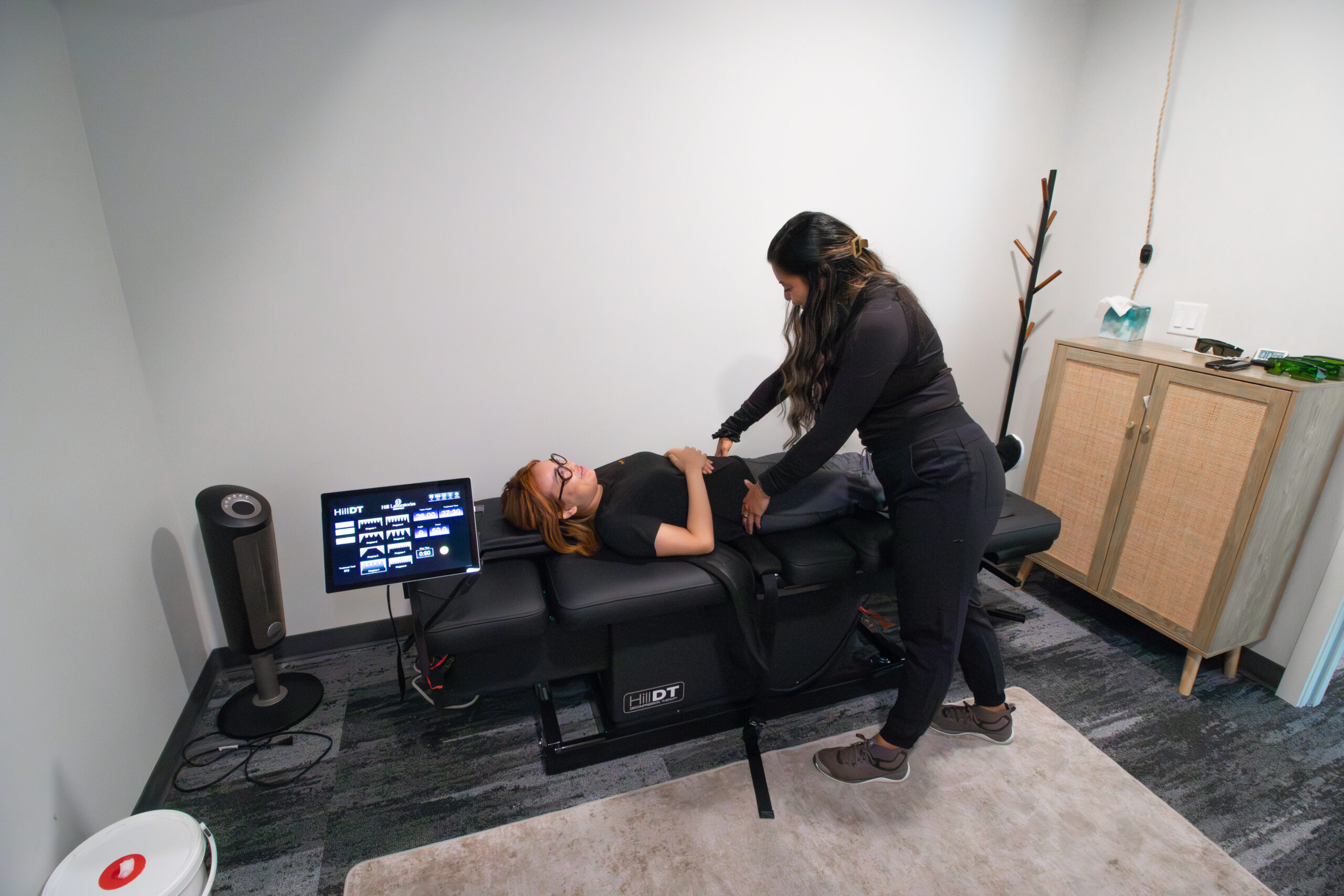
Spinal Decompression Therapy
Spinal decompression therapy uses a specialized table to apply gentle, controlled traction to the spine. Depending on where your symptoms are located, treatment may focus on:
- The lower back with lumbar decompression
- The neck with cervical decompression
The goal is to reduce pressure around the affected area and create a more comfortable environment for irritated tissues and nerves.
Chiropractic Care
Chiropractic adjustments and other hands-on techniques may be used to improve joint mobility and reduce tension in the surrounding muscles. Treatment is adjusted based on your comfort, symptoms, and individual presentation.
Functional Rehabilitation
Exercise is often an important part of long-term recovery. Through our functional rehabilitation program, your care plan may include exercises designed to improve:
- Core strength
- Spinal stability
- Mobility
- Movement control
- Confidence with everyday activities
The goal is not just to help you feel better now, but also to help your body move more comfortably over time. If you’ve been told surgery is your only option, our article on spinal decompression vs. back surgery outlines some questions you may want to ask before deciding on your next step.
Frequently Asked Questions
What is a slipped disc in your back?
A slipped disc is another name for a herniated disc. The disc does not actually move out of place. Instead, some of the softer material inside the disc pushes through a crack in the outer layer and may irritate a nearby nerve.
What does a herniated disc feel like?
Symptoms can vary. Some people experience sharp, burning, or shooting pain that travels into the leg or arm. Others may notice numbness, tingling, weakness, or localized back or neck pain.
Some herniated discs cause no symptoms at all.
Is a bulging disc less serious than a herniated disc?
Not necessarily. A bulging disc generally keeps the inner material contained, while a herniated disc involves material pushing through the outer layer. However, either condition may cause symptoms depending on whether nearby nerves are irritated.
Your symptoms and physical assessment often matter more than the wording on an MRI report.
Can a herniated disc cause a pinched nerve?
Yes.
If disc material irritates or presses on a nearby nerve root, it may cause what is commonly called a pinched nerve.
Symptoms can include:
- Radiating pain
- Tingling
- Numbness
- Weakness
Our approach to pinched nerve treatment may include chiropractic care, soft tissue techniques, and functional rehabilitation.
Who treats herniated discs in Seattle?
Several types of healthcare providers may help manage herniated discs, including chiropractors, physicians, physical therapists, and spine specialists. At Tangelo Health, our chiropractors in Green Lake and West Seattle assess disc-related back and neck pain and may use spinal decompression, chiropractic care, and rehabilitation as part of a personalized treatment plan.
If your symptoms suggest that imaging, medical evaluation, or a specialist referral may be appropriate, we can help guide you toward the right next step.
Understanding Your Disc Is the First Step
Hearing words like bulging, herniated, or slipped disc can sound intimidating, but the terminology is often more complicated than the condition itself. A slipped disc is simply another name for a herniated disc, while a bulging disc involves the outer portion of the disc extending beyond its usual space.
Most importantly, an MRI finding does not always tell the whole story. A thorough assessment can help connect what appears on imaging with how you actually feel and move, so your treatment plan is based on you, not just your scan.
Find Support at Tangelo Health
If back or neck pain is keeping you from moving comfortably, the team at Tangelo Health can help you better understand your symptoms and explore your treatment options.
References
- Mayo Clinic Staff. (n.d.). Herniated disk: Symptoms and causes. Mayo Clinic.
https://www.mayoclinic.org/diseases-conditions/herniated-disk/symptoms-causes/syc-20354095 - Mayo Clinic Staff. (2026, May 14). Bulging disk vs. herniated disk: What’s the difference? Mayo Clinic.
https://www.mayoclinic.org/diseases-conditions/herniated-disk/expert-answers/bulging-disk/faq-20058428 - Mayo Clinic Staff. (n.d.). Herniated disk: Diagnosis and treatment. Mayo Clinic.
https://www.mayoclinic.org/diseases-conditions/herniated-disk/diagnosis-treatment/drc-20354101